CITY WITHOUT FATHERS
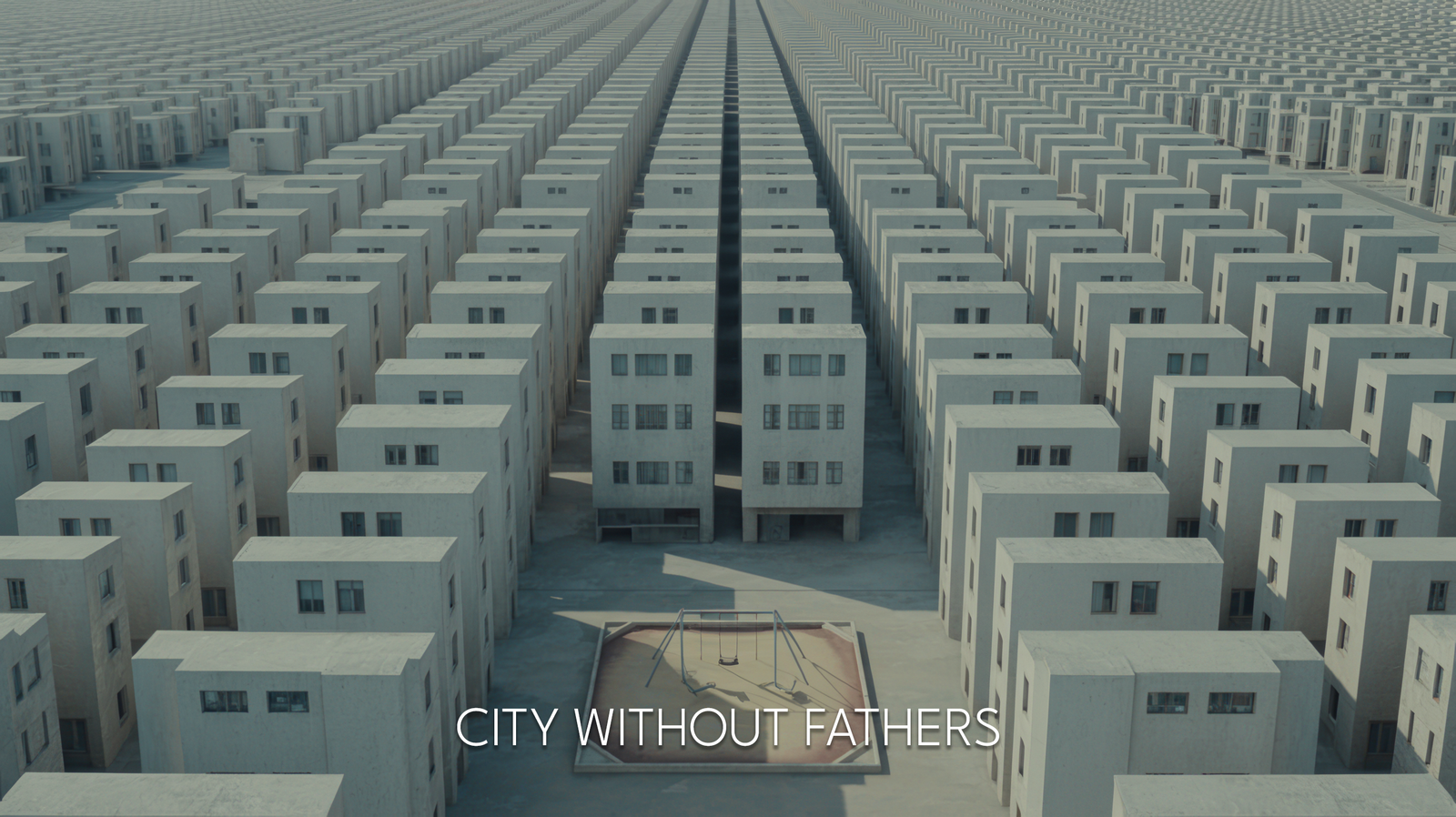
Amir never met his father.
In the city where he grew up, that wasn’t unusual.
In fact, it was normal.
Seventeen years earlier, the government had passed something called The Harmony Act.
The idea sounded simple:
remove the outdated structure of traditional families and raise children collectively so every child would grow up equal.
Fathers, the law argued, were unnecessary.
Some people protested. Some left the country.
But most stayed.
Over time, the protests faded, and the new system became ordinary.
Children were born in state hospitals.
Mothers could stay involved, but the real responsibility belonged to the Collective—
a network of schools, counselors, and institutions designed to shape every child into a balanced citizen.
Amir had grown up inside that system.
Every morning began the same way.
The dormitory lights turned on at six.
Forty boys woke up at the same time, dressed in identical grey uniforms,
and walked together to the learning halls.
They studied mathematics, languages, science—
and something the teachers called Social Stability.
In Social Stability class, they learned why the old world had failed.
Too much conflict.
Too much inequality.
Too many broken families.
The new world was supposed to fix that.
No fathers meant no dominance,
no patriarchal authority,
no imbalance of power.
At least, that was the theory.
Amir never thought much about it—
until the day he found the photograph.
It happened during cleaning duty in one of the storage rooms beneath the academy.
Dusty shelves.
Old boxes.
Forgotten equipment from before the Harmony Act.
At the bottom of a crate filled with paper documents—something rare in a city that had gone almost fully digital—
he saw a small photo.
A man holding a little boy on his shoulders.
The boy was laughing.
The man looked proud in a quiet, simple way.
Amir stared at the picture longer than he meant to.
There was something strange about it.
Something warm.
Something missing from his world.
Later that evening, during dinner, he showed the photo to his friend Daniel.
Daniel frowned.
“Where did you get that?”
“Storage room,” Amir said.
Daniel glanced around nervously.
“You should throw that away.”
“Why?”
Daniel lowered his voice.
“My cousin got questioned last year for keeping old family photos.”
“Questioned?”
“Yeah. They said nostalgia is destabilizing.”
Amir looked down at the picture again.
Destabilizing.
The word felt strange in his mouth.
That night, Amir couldn’t sleep.
He kept staring at the photo.
At the man.
At the boy on his shoulders.
And one question kept returning to his mind.
What does it feel like to have a father?
Over the next few weeks, Amir started noticing things he had never paid attention to before.
The teachers always avoided the word father.
Old books in the library had entire pages removed.
Historical records before the Harmony Act had gaps—missing sections, blurred names, redacted photographs.
It was as if half of history had been carefully erased.
Then one evening, Daniel came running into the dormitory.
“You need to see something.”
They sneaked out after curfew and walked through the empty streets of the residential district.
The city was quiet, its towers glowing softly in the night.
Daniel led him toward an abandoned metro entrance.
Inside, several teenagers were gathered.
And among them were men.
Older men.
Amir froze.
He had seen adult men before—teachers, officials, security officers.
But these men looked different.
They looked… ordinary.
One of them stepped forward.
“You must be Amir.”
His voice was calm.
“Who are you?” Amir asked.
The man smiled faintly.
“Someone your city decided you didn’t need.”
The room fell silent.
The man pointed to the photograph in Amir’s hand.
“Where did you find that?”
“In storage,” Amir said.
The man nodded slowly.
“That was taken before the Harmony Act.”
“Who is the man in the picture?”
The man looked at him for a long moment.
Then he said something that made Amir’s chest tighten.
“That’s me.”
Amir looked back at the photo.
Then at the man.
“Then… the boy…”
The man’s eyes softened.
“That’s my son.”
The words felt almost forbidden in the air.
Amir realized something in that moment.
The Harmony Act had never erased fathers.
It had only erased them from the world children were allowed to see.
Over the following weeks, Amir returned to the underground meetings.
The men there called themselves The First Generation—
fathers who had been pushed out of the official structure of society.
Some had lost contact with their children entirely.
Others had been allowed to see them only under supervision.
They were not criminals.
They were simply unnecessary.
Amir listened to their stories.
Stories about raising children.
Teaching them to ride bicycles.
Carrying them on their shoulders.
Telling them stories before bed.
Things Amir had never experienced.
Slowly, something inside him began to shift.
For the first time, the perfectly balanced world around him started to feel incomplete.
One night, he asked the man from the photograph:
“Why didn’t you leave the city?”
The man thought for a moment.
“Because my son is still here.”
Amir felt something heavy settle in his chest.
Then he asked the question he had been afraid to say out loud.
“What if the system is right?”
The man looked at him carefully.
“Maybe it solved some problems.”
A pause.
“But every solution has a cost.”
“What was the cost?”
The man looked around the underground room—at the hidden group of fathers.
Then he said quietly:
“You.”
The next morning, Amir walked back into the academy.
The same hallways.
The same uniforms.
The same lessons about harmony.
But everything felt different now.
Because for the first time in his life,
Amir understood something the system had tried very hard to hide.
A perfectly balanced society had been built.
But it had been built by removing something human.
And once you saw that absence — you could never unsee it.