THE DAY WHEN INTERNET DISAPPEARED
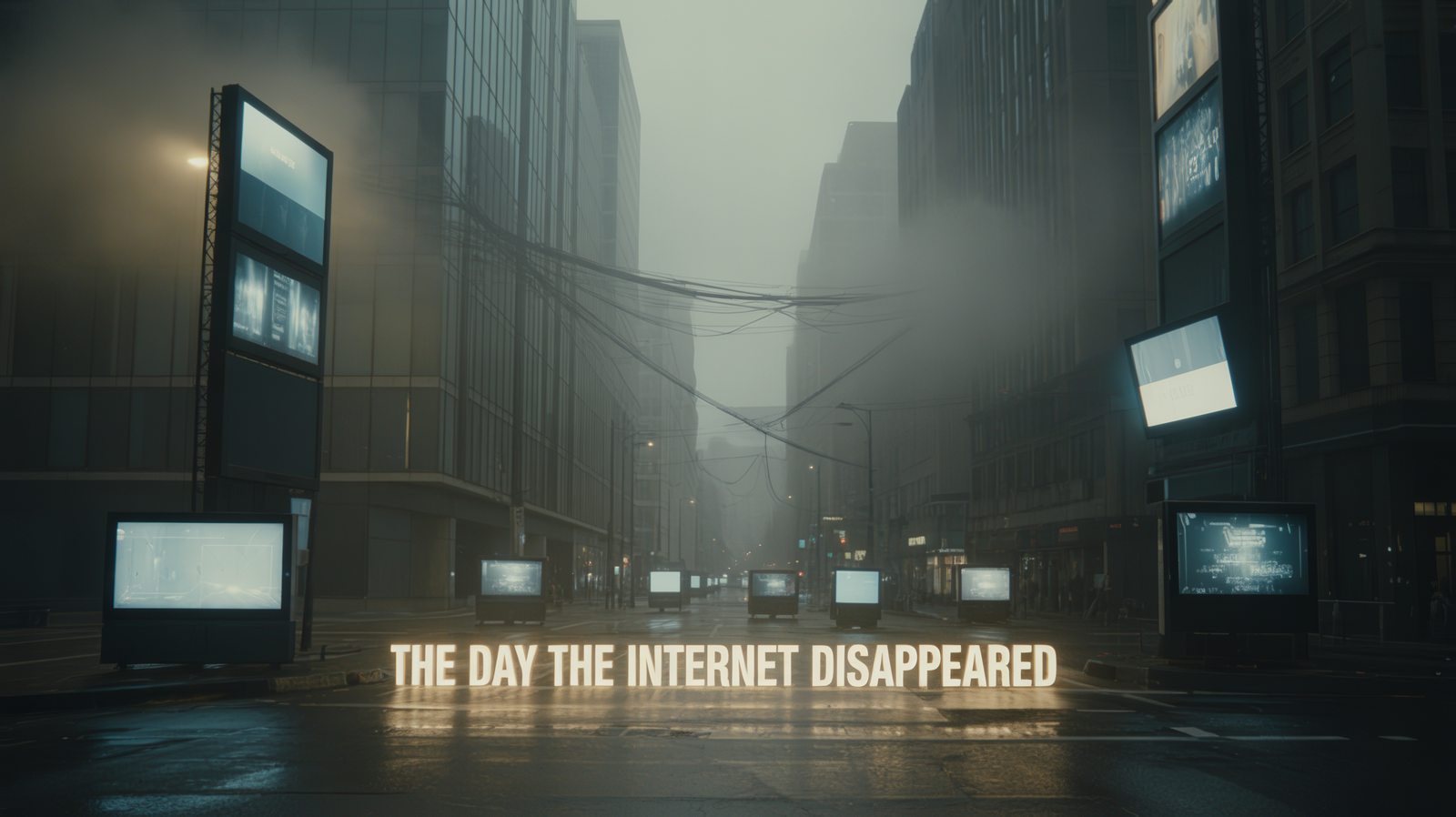
The internet didn’t crash.
There was no warning.
No error message.
No slow decline.
At 9:17 AM, it simply… stopped.
Lucas noticed it when his music cut out.
He was walking to work, half-awake, letting the algorithm decide his mood for the morning. The song ended mid-verse.
No fade.
No transition.
Silence.
He frowned, tapped his phone, refreshed the app.
Nothing.
No signal.
Around him, people slowed.
Then stopped.
Screens in hands.
Eyes fixed.
Waiting.
For something that didn’t come back.
By 9:30, confusion spread.
At a café on the corner, a woman tried to pay.
“It’s not working,” the cashier said.
“It must be,” the woman replied.
“I just used it.”
The cashier shook her head.
“It’s not declining,” she said quietly.
“It’s not doing anything.”
By 10:00, the city had changed.
Traffic lights froze.
Digital billboards went blank.
Office buildings filled with people staring at lifeless screens.
Phones couldn’t call.
Messages couldn’t send.
Maps couldn’t load.
The world didn’t lose connection.
It lost direction.
Lucas went home.
His apartment felt different without the constant background noise.
No notifications.
No updates.
No endless stream of information.
Just silence.
He turned on the TV.
Static.
He opened his laptop.
Offline.
He checked the router.
It blinked.
Pointlessly.
By the afternoon, rumors began.
Not online.
In voices.
People talking in streets.
In hallways.
In crowded rooms.
Some said it was a cyberattack.
Others said it was a system failure.
Some whispered something else.
That it had been done on purpose.
By evening, reality hit.
Shops couldn’t process payments.
Banks were inaccessible.
Hospitals struggled without records.
Flights were grounded.
And the most unsettling part—
no one knew what was happening beyond what they could physically see.
The world shrank.
To streets.
To rooms.
To voices.
On the second day, something changed.
People started talking again.
Not through screens.
In person.
Neighbors introduced themselves.
Strangers shared information.
Groups formed in public squares.
Trying to understand.
Trying to reconnect.
Lucas met his neighbor for the first time.
Victor.
Older.
Calm.
“Feels strange, doesn’t it?” Victor said.
“What?” Lucas asked.
“This,” he replied, gesturing around them.
“The silence.”
Lucas nodded.
“It feels like something’s missing.”
Victor smiled faintly.
“Or maybe something stopped distracting us.”
By the third day, people adapted.
Cash returned.
Handwritten notes appeared.
Word-of-mouth replaced news.
Life slowed.
Without constant updates, urgency faded.
Without algorithms, decisions felt heavier.
More personal.
But not everything improved.
Without reliable information, rumors spread faster.
Fear moved quickly.
Truth moved slowly.
And without digital systems—
control weakened.
On the fifth day, the announcement came.
Not online.
On the radio.
A calm voice.
Official.
“This is a global systems shutdown initiated under emergency protocol.”
A pause.
“The internet has not failed.”
Another pause.
“It has been disabled.”
Lucas listened carefully.
The voice continued.
“For years, global infrastructure has become critically dependent on interconnected digital systems.”
“This dependency created vulnerabilities beyond control.”
“We did not lose the internet.”
“We chose to remove it.”
No timeline.
No explanation.
Just silence.
That night, Lucas sat by the window.
The city was darker.
Without screens, without artificial glow—
the sky looked different.
Clearer.
For the first time in years—
he could see the stars.
He realized something then.
The internet didn’t just connect the world.
It shaped it.
What people saw.
What they believed.
What they cared about.
And without it—
people were lost.
But also—
free.
Weeks passed.
Life continued.
Slower.
Messier.
Less certain.
But real.
Months later, the internet still hadn’t returned.
Some demanded it back.
Others didn’t.
Debates happened in public.
Not in comment sections.
Truth became harder to verify.
But also harder to control.
One evening, Lucas sat outside with Victor again.
“Do you think it will come back?” Lucas asked.
Victor looked at the sky.
“Of course,” he said.
“Why?”
“Because people don’t just use it,” Victor replied.
“They depend on it.”
A pause.
“Just like everything before it.”
Lucas looked around.
At people talking.
Arguing.
Laughing.
Getting things wrong.
Figuring things out.
The internet hadn’t died.
It had been taken away.
And for the first time in a long time—
the world had to remember how to exist without being told how.