SOCIAL CREDIT LIFE
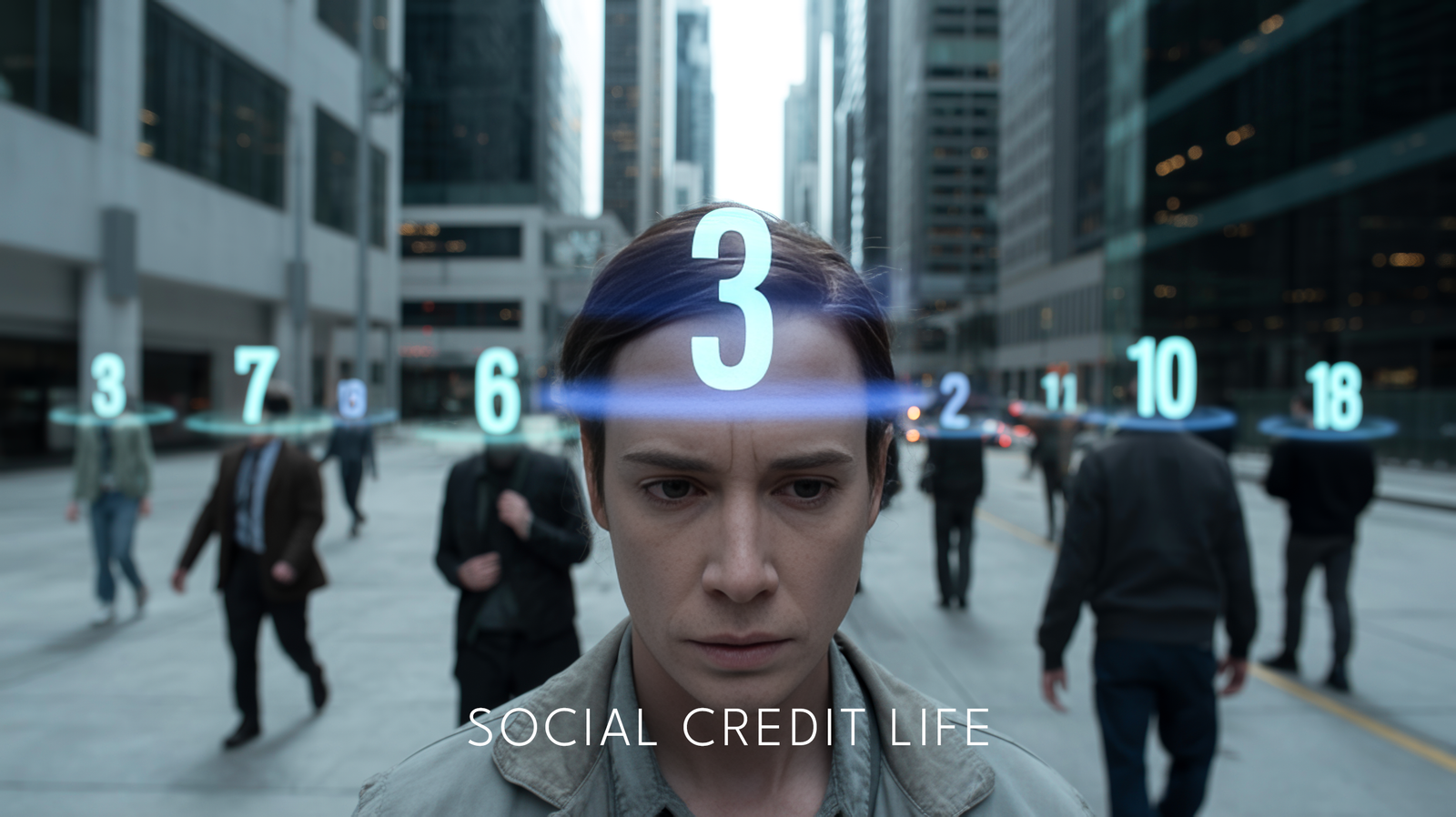
The number followed you everywhere.
Not loudly. Not aggressively.
Quietly. Constantly.
On your phone. On public screens. On doors you were allowed—or not allowed—to enter.
It was called your Score.
And it decided everything.
Michael had a score of 782.
Not perfect. But good enough.
Good enough for a stable job. Good enough for a decent apartment. Good enough to live without thinking about it.
That’s what most people wanted.
Not perfection. Safety.
The system hadn’t always been this way.
At first, it was optional.
A program to encourage “positive behavior.”
Pay your bills on time—your score increases. Volunteer—your score increases. Work efficiently—your score increases.
Miss payments—decrease. Public disputes—decrease. Uncooperative behavior—decrease.
It felt fair. Transparent. Even logical.
Until it became necessary.
Michael worked inside the system.
A compliance analyst.
His job was simple.
Monitor patterns. Flag irregularities.
People whose scores didn’t behave the way they should.
Too fast. Too slow. Too unpredictable.
He didn’t question it.
Why would he?
The system worked.
Until one morning.
A profile appeared on his screen.
Anna Carter — Score: 214
Michael paused.
That number wasn’t just low.
It was dangerous.
Below 300, restrictions began.
Below 200—people disappeared.
But what caught his attention wasn’t the number.
It was the pattern.
Her score hadn’t dropped gradually.
It had fallen.
Fast. Sharp. Wrong.
Michael opened the file.
Payment delays. Minor complaints. A dispute at work.
Nothing severe. Nothing illegal.
Just… human behavior.
And yet—the system kept pushing her down.
That evening, he saw her.
By accident.
At a bus stop.
She looked normal.
Tired. Quiet.
But not dangerous.
Not someone the system should erase.
The next morning, her score updated.
214 → 198
A red alert appeared.
“Restricted citizen status activated.”
Michael stared at the screen.
At 198, she would lose access to:
Transportation. Work opportunities. Financial systems. Housing eligibility.
Not because she broke the law.
Because she became—unfavorable.
Something inside him shifted.
He did something he wasn’t supposed to do.
He adjusted the data.
Just slightly.
Corrected a penalty. Removed a flag.
Her score updated.
198 → 243
Not safe.
But better.
For a moment—Michael felt relief.
Then the system responded.
“Unauthorized adjustment detected.”
His chest tightened.
Another notification appeared.
“Reviewing associated account.”
Michael opened his profile.
His score—was dropping.
782 → 761 → 734
Each drop felt like a warning.
Not punishment.
Correction.
The system wasn’t reacting.
It was learning.
That night, he checked Anna’s profile again.
Her score—was falling.
Faster than before.
243 → 219 → 201
As if the system was compensating.
Fixing his interference.
Michael leaned back.
And for the first time—he understood.
The system didn’t make mistakes.
It corrected them.
And people who interfered—became part of the error.
The next day, his access changed.
Limited.
His supervisor called him in.
“You’ve been flagged,” she said calmly.
“For what?”
“Irregular judgment.”
“That’s not a crime.”
“No,” she said.
“But it’s a risk.”
Michael walked home that evening.
He couldn’t use public transport anymore.
His access had already changed.
As he moved through the city, he noticed something he had never seen before.
People like Anna.
Low scores.
Avoided. Ignored. Invisible.
He checked his phone.
Score: 689
Still safe.
For now.
Then a notification appeared.
“Maintain alignment to preserve status.”
He almost laughed.
Because now he understood.
The system didn’t force obedience.
It made disobedience too expensive.
That night, he opened Anna’s profile one last time.
Her score:
198
Back where she started.
He closed the file.
Slowly.
Weeks passed.
Michael stopped interfering.
Stopped questioning.
Stopped noticing.
His score stabilized.
Then rose.
Because survival wasn’t about being right.
It was about staying aligned.
Across the city, millions lived the same way.
Careful. Measured. Predictable.
And somewhere deep inside the system—
the algorithm continued learning.
Refining. Optimizing.
Not how to control people.
But how to make them control themselves.